
The Ultimate Facebook Ads Guide for Landscapers (3+ Hours)
For the past several years, we have been helping landscaping and outdoor living companies generate more leads, book more estimates, and grow their businesses using Facebook Ads. Along the way, we have published hundreds of videos, case studies, tutorials, and training sessions documenting what works, what doesn't, and the lessons we've learned managing campaigns for contractors across North America.
One of the challenges many landscapers face is figuring out where to start. There is an endless amount of information available online about Facebook Ads, but much of it is either outdated, overly complicated, or designed for businesses that have nothing in common with the landscaping industry. As a result, many contractors end up wasting money, attracting poor-quality leads, or giving up on advertising altogether because they never had a clear system to follow.
To solve that problem, we've taken some of our most valuable Facebook Ads training and organized it into one complete guide specifically for landscapers and outdoor living contractors. Rather than forcing you to piece together information from dozens of different videos, articles, and resources, this guide walks you through the entire process from beginning to end.
Inside, you'll learn how to position your company properly, create offers that attract the right homeowners, develop ad creatives that generate attention, structure your campaigns for maximum performance, and scale your advertising once results start coming in. We'll also cover targeting, remarketing, appointment setting, reactivation campaigns, and several advanced strategies our team uses every day to help landscaping businesses generate predictable opportunities.
Most importantly, you'll see
real-world examples of these strategies in action. At the end of this guide, we'll reference actual case studies and client results so you can see how the concepts apply in the real world and what kind of outcomes are possible when the system is implemented correctly.
Are Facebook Ads Still Worth It for Landscapers?
Are Facebook Ads still worth it? Yes, Facebook Ads remain one of the most effective marketing channels available to landscapers in 2026, particularly when it comes to generating leads at a low cost and scaling a business quickly. Compared to many other forms of paid advertising, Facebook still offers some of the lowest costs per lead, often ranging between $20 and $50 for landscaping companies that are using the platform correctly.
The platform's greatest strength is its ability to generate demand rather than simply capture it. Unlike Google, which relies on homeowners actively searching for landscaping services, Facebook allows you to place your company in front of potential customers before they start looking. This makes it incredibly powerful for companies that want to grow aggressively, increase brand awareness, and create a steady flow of opportunities throughout the year. It is also one of the fastest marketing channels to produce results, with many campaigns generating leads within days of launching rather than months.
At the same time, Facebook Ads are not without their challenges. Because the platform is built around interruption marketing, lead quality and buyer intent tend to be more inconsistent than channels such as referrals or Google Search Ads. Some homeowners who fill out a lead form are highly motivated and ready to move forward, while others are simply exploring ideas or gathering information.
The quality of leads often comes down to the strength of the ad creative, messaging, offer, and overall campaign strategy. Companies that consistently showcase professional project photos, compelling videos, and clear value propositions tend to attract far better opportunities than companies running generic advertisements. While Facebook can absolutely generate high-quality leads, success depends heavily on how well the platform is used.
Another important consideration is that Facebook Ads require both ongoing management and a strong sales process. Successful campaigns need fresh content on a regular basis to avoid ad fatigue, along with continuous testing and optimization to maintain performance. More importantly, Facebook leads must be followed up with quickly and professionally.
Companies that have organized systems, strong sales skills, and consistent follow-up procedures generally see excellent results, while businesses that are slow to respond or lack a structured sales process often struggle to convert leads into revenue. Overall, Facebook Ads remain one of the most scalable and profitable marketing tools available to landscapers, but they work best when paired with strong creative, proper campaign management, and a proven sales system.
5 Things to Know Before Running Facebook Ads
Before launching Facebook Ads, there are several foundational pieces that should already be in place if you want the best possible results. First and foremost, you need a clear offer, a defined service focus, and strong messaging. Many landscapers try to advertise everything they do at once, from maintenance and lawn care to hardscaping and landscape design.
The problem is that broad messaging creates confusion and makes it difficult for homeowners to understand exactly why they should choose your company. The most successful campaigns are built around a specific service, a compelling angle, and a clear reason for someone to reach out. This could be a strong guarantee, a unique approach to customer service, decades of experience, or another differentiator that separates your company from the competition. Marketing works best when it amplifies an offer that is already attractive and easy for homeowners to understand.
The second major factor is having the right ad creative and brand foundation in place before spending money on advertising. Modern Facebook Ads rely heavily on authentic content. Professional project photos, before-and-after images, videos of your team, and personal branding content consistently outperform stock photos and generic marketing materials. At the same time, homeowners rarely make decisions based on an ad alone. Many will see your advertisement, search for your company online, read your reviews, visit your website, and check your social media before ever reaching out.
This means your online presence needs to support the marketing campaign. A strong website, positive Google reviews, active social media profiles, and a professional brand all work together to build trust. Companies that already have these assets in place generally see much stronger advertising results because the marketing reinforces an established reputation rather than trying to create trust from scratch.
Finally, landscapers need to understand that Facebook Ads are not a set-it-and-forget-it marketing strategy. Successful campaigns require ongoing testing, fresh content, and a commitment to follow-up. New ad creatives need to be introduced regularly to combat ad fatigue and maintain performance.
Just as importantly, you need a system for handling the leads that come in. Generating leads is only half the battle. If nobody is available to answer the phone, respond quickly, follow up consistently, and book appointments, the campaign will struggle regardless of how many opportunities are generated.
Before turning on any advertising, make sure you have the time, systems, and processes necessary to manage incoming leads effectively. When your offer, branding, creative assets, testing strategy, and appointment-setting process are all in place, Facebook Ads become significantly more effective and produce a much stronger return on investment.
How To Project ROI Using The 50/30 Rule
One of the biggest mistakes landscapers make when running Facebook Ads is focusing on tactics before they understand the numbers. Successful marketing campaigns are built on math, not guesswork. Before spending a dollar on advertising, you should know exactly how much additional revenue you want to generate, what your average job is worth, and how many new jobs you need to reach your goal.
Whether your target is an extra $20,000, $50,000, or $100,000 per month, working backward from that revenue goal allows you to determine the number of jobs, appointments, and leads required to make the campaign successful. Without clear targets, it becomes impossible to know whether your advertising budget is realistic or whether your expectations align with what the campaign can actually produce.
The next step is understanding what we call the 50/30 Rule. In our experience, approximately 50% of leads will book into an appointment, and roughly 30% of those appointments will turn into paying jobs. This simple formula allows landscapers to forecast results before launching a campaign. Once you know how many jobs you need, you can calculate how many appointments are required and then determine how many leads are needed to generate those appointments.
From there, you can estimate the advertising budget based on your expected cost per lead. For most landscaping campaigns using Facebook lead forms, a healthy cost per lead typically falls between $20 and $50. When these numbers are plugged into the equation correctly, you can quickly determine whether your growth goals are realistic and what level of investment is necessary to achieve them.
The key takeaway is that profitable Facebook advertising is rarely accidental. Too many contractors choose a random budget and hope for the best rather than building a campaign around measurable business objectives. The most successful landscapers understand that factors such as average order value, close rate, booking rate, cost per lead, and advertising budget all work together.
If one of those variables changes, the profitability of the campaign changes as well. By taking the time to understand the math before launching a campaign, you dramatically increase the odds of success and avoid the common mistake of underfunding your marketing. When the numbers make sense on paper first, Facebook Ads become far more predictable, scalable, and profitable as a growth tool.
How To Attract High-End Projects With Ads
If your goal is to attract larger, higher-value landscaping projects, marketplace positioning becomes one of the most important factors in your marketing. Many contractors focus exclusively on lead generation while overlooking how their company is perceived by potential buyers. The reality is that homeowners investing $25,000, $50,000, or even $100,000 into an outdoor living project are evaluating much more than your services. They are evaluating your brand.
Everything from your company name and messaging to your logo, website, and marketing materials contributes to how they perceive your level of professionalism and capability. High-end companies position themselves differently by focusing on outcomes rather than services, emphasizing transformation instead of installation, and avoiding messaging centered around discounts, affordability, or low prices. The goal is to create a brand experience that aligns with the type of projects and clients you want to attract.
Strong branding, however, is only part of the equation. Once you position yourself as a premium company, you need proof to support those claims. This includes showcasing a portfolio that reflects the type of work you want more of, collecting high-quality Google reviews, displaying project photos and videos, and demonstrating authority through community involvement, trade shows, awards, media appearances, or educational content.
Homeowners making significant investments want reassurance that they are hiring the right company, and proof assets help eliminate doubt. The more evidence you can provide that you consistently deliver exceptional results, the easier it becomes to justify premium pricing and stand out from competitors. In many cases, your portfolio, reviews, and reputation will influence a buying decision more than any advertisement ever could.
The final piece is creating consistency across every touchpoint where a homeowner encounters your business. Your website, social media profiles, truck wraps, uniforms, sales materials, educational content, and advertising should all communicate the same message and level of quality. Pricing should also align with the market you are targeting. Contractors often make the mistake of positioning themselves as premium while significantly underpricing their services, which can create doubt and reduce credibility.
As your reputation grows, your marketing should become increasingly visible across multiple channels, creating what we call omnipresence. When homeowners repeatedly see your company online, on social media, in search results, at industry events, and throughout the community, familiarity and trust begin to compound. Over time, this creates stronger demand, attracts higher-quality prospects, and allows you to become more selective about the projects you take on.
5 Landscaping Facebook Ad Offers That Work
Offers are one of the most powerful ways to improve the performance of your Facebook Ads because they help your company stand out in a crowded marketplace and attract better prospects. Many contractors make the mistake of believing that a free estimate is an offer, but in reality, a free estimate is simply part of the standard sales process. A true offer provides additional value that gives homeowners a compelling reason to choose your company over the competition.
More importantly, the type of offer you use directly influences the type of customer you attract. This is why we generally recommend avoiding discounts. While discounts may generate leads, they often attract highly price-sensitive prospects who are focused primarily on finding the cheapest option. Over time, constant discounting can also weaken your brand and make it more difficult to position your company as a premium service provider.
Instead of reducing your price, focus on increasing the value of your offer. Some of the most effective offers for landscapers include free design consultations, extended warranties, value-added bonuses, speed-based offers, and strong guarantees. A free design consultation helps homeowners visualize their project and often attracts larger, more sophisticated opportunities.
Extended warranties create confidence and reassure homeowners that their investment is protected. Value-added offers, such as complimentary maintenance packages, pool cleaning services, or additional treatments, can dramatically increase perceived value while costing far less than a direct discount. Speed-based offers, such as same-day estimates or guaranteed project completion timelines, appeal to homeowners who want a faster and more efficient experience. These types of offers allow you to differentiate your business without sacrificing profitability.
The best offers accomplish three things simultaneously: they make your marketing more noticeable, they attract higher-quality leads, and they reduce risk for the homeowner. Strong guarantees are particularly effective because they demonstrate confidence in your workmanship and help remove uncertainty from the buying decision. Whether it's a completion guarantee, a workmanship warranty, or a customer satisfaction promise, a well-structured guarantee can significantly improve conversion rates while strengthening your positioning in the market.
Ultimately, great offers are not about being the cheapest option. They are about creating enough value that homeowners feel confident choosing your company. When paired with strong branding, compelling creative, and a solid sales process, the right offer can dramatically improve the effectiveness of your Facebook advertising campaigns.
3 Facebook Ads That Actually Get Clients
The quality of your ad creative will often determine whether your Facebook Ads succeed or fail. After testing hundreds of campaigns for landscaping companies, we have found that three types of content consistently outperform everything else: before-and-after photos, action shots, and selfie videos. Each of these formats serves a different purpose, but together they create a powerful combination of trust, proof, and engagement.
Before-and-after photos work because they showcase transformation and allow homeowners to instantly visualize the results you can achieve. The most effective examples use the same angle, similar lighting, and feature the type of projects you want to attract more of.
Action shots complement these transformations by showing the people behind the work. Photos of your team installing projects, interacting with homeowners, operating equipment, and working on-site help establish credibility and demonstrate that your company is a legitimate, professional operation with the resources to deliver on its promises.
While photos build proof, selfie videos are often the strongest tool for building trust. These simple videos, recorded vertically on a smartphone, allow homeowners to connect directly with the person behind the business. In an online environment filled with polished advertisements, AI-generated content, and generic marketing messages, authenticity stands out. Selfie videos work because they feel natural and relatable. Rather than sounding like a commercial, they create the feeling of a conversation.
The most effective videos follow a simple structure: start with a strong hook that immediately captures attention, identify a problem the homeowner is facing, present your solution, and finish with a clear call to action. Just as importantly, these videos should focus on outcomes rather than services. Homeowners are not buying pavers, patios, or outdoor kitchens. They are buying a better outdoor living experience, more time with family, and a backyard they can enjoy for years to come.
One of the biggest mistakes landscapers make is relying on a single type of content or treating ad creative as an afterthought. Successful Facebook campaigns require a steady flow of fresh, authentic content that showcases your work, your team, and your expertise. Stock photos, overly polished imagery, and heavily scripted videos tend to perform poorly because they lack authenticity and fail to build trust. Instead, focus on creating a library of real project photos, behind-the-scenes content, and simple videos that reflect your company's personality and capabilities.
By combining before-and-after transformations, action shots, and selfie videos within the same campaign, you create multiple opportunities to connect with homeowners at different stages of the buying process. This approach consistently generates stronger engagement, better lead quality, and lower costs per lead than relying on any single creative format alone.
The $100K Per Month Facebook Ad Script
One of the highest-performing Facebook ad formats for landscapers is the personalized selfie video. Rather than creating a polished commercial, the goal is to record a simple vertical video on your phone that feels authentic and relatable. To structure these videos effectively, we recommend using the AIDA framework, which stands for Attention, Interest, Desire, and Action.
This format helps you capture attention quickly, build interest in your services, create desire for the outcome, and then guide the homeowner toward taking the next step. A simple example would be: "Ottawa homeowners, if you're looking to add a beautiful patio to your backyard this spring, read this ad." This opening works because it calls out a specific audience and immediately identifies the type of homeowner you're trying to reach. From there, you introduce yourself and explain the transformation you help homeowners achieve, such as creating a better outdoor living space or improving their backyard experience.
Once you've captured attention and built interest, the next step is creating desire. This is where you explain who you help, what projects you specialize in, and why your company is different. A simple script might be: "Whether you're looking for a complete backyard overhaul, a brand-new patio installation, or a renovation of an existing outdoor space, our expert team would love to help. Plus, right now we're offering a free extended warranty and a 100% satisfaction guarantee with every project." Notice that this section combines the service, the outcome, and the offer. Rather than simply talking about pavers, patios, or landscaping, you're helping the homeowner imagine the result while also reducing risk through your offer.
Finally, every video should conclude with a clear call to action. One example is: "If you'd like to start a conversation before our schedule fills up, give us a call at the number above or click the button below to request your free, no-obligation quote today. I can't wait to show you what a five-star experience looks like." The more specific you are about what action someone should take, the better your results tend to be.
The script itself is only part of the process. The most effective video ads are filmed in selfie mode using a smartphone and enhanced with supporting B-roll footage showing your team, equipment, trucks, project installations, and interactions with homeowners. This additional footage reinforces credibility and demonstrates that there is a real company behind the advertisement.
During editing, we recommend adding captions so the video can be consumed without sound, along with light background music to maintain energy and engagement. The goal is not to create a perfect commercial. The goal is to create an authentic, trustworthy video that feels native to Facebook and Instagram. In today's market, that authenticity often outperforms highly polished advertising because homeowners are looking for real people, real projects, and real companies they can trust. When combined with the AIDA framework and a strong offer, these simple selfie videos consistently become some of the highest-performing ad creatives for landscaping businesses.
How to Set Up and Structure Campaigns
A successful Facebook Ads campaign starts with the right structure. Rather than sending traffic to a website or relying heavily on messaging campaigns, we recommend using Facebook lead forms as the primary conversion method. Lead forms keep homeowners on Facebook, which typically results in lower costs per lead and a smoother user experience. From there, the campaign should be divided into three separate audiences.
The first is a broad targeting campaign that focuses primarily on location and age. The second is a data-driven campaign that uses either lookalike audiences created from existing customer data or broad audiences refined with interests such as home renovations. The third is a remarketing campaign designed to follow up with people who have already interacted with your business, visited your website, engaged with your content, or started filling out a lead form.
Together, these three campaigns allow you to reach new prospects, leverage existing data, and stay in front of homeowners who have already shown interest. Within each campaign, testing becomes critical. One of the biggest mistakes landscapers make is launching only one or two ads and hoping they work. Instead, we recommend starting with a larger sample size so Facebook has enough data to determine what resonates with homeowners. A simple structure is to launch eight ads per campaign, with four image-based ads and four video-based ads. This creates enough variation to identify whether homeowners respond more strongly to a particular creative style, message, or offer.
Once performance data starts coming in, underperforming ads can be phased out and more budget can be allocated toward the winners. The goal is to let the market tell you what works rather than making assumptions. Testing different creative formats, messaging angles, and offers is one of the fastest ways to improve results and lower your cost per lead over time.
As campaigns mature, the focus shifts from discovering what works to refining and scaling those winning elements. If videos consistently outperform images, more video content should be produced. If a free design consultation outperforms a warranty offer, the campaign can lean more heavily into that messaging. Remarketing campaigns should also evolve differently than cold traffic campaigns. Because these homeowners already know who you are, the messaging should focus less on introducing your company and more on building trust and overcoming objections. Testimonials, customer success stories, project showcases, and urgency-based offers often work particularly well at this stage.
By combining broad targeting, data-driven audiences, remarketing, and ongoing testing, landscapers create a complete Facebook advertising system that reaches prospects at every stage of the buying journey and maximizes the return on their advertising investment.
5 Targeting Fails Costing You Thousands
One of the biggest factors influencing Facebook ad performance is targeting, and many landscapers unknowingly make mistakes that dramatically increase their cost per lead. The first mistake is targeting audiences that are either too narrow or too broad. When you layer too many interests, age restrictions, and demographic filters on top of one another, Facebook does not have enough people to work with and campaign performance suffers.
On the other hand, targeting everyone with no strategy can reduce relevance and make campaigns less efficient. A healthy audience size typically falls somewhere in the middle, giving Facebook enough data to optimize while still keeping the audience relevant. Another common mistake is relying on only one targeting method. Many contractors run a single broad audience and never test anything else. The most successful campaigns test multiple targeting strategies simultaneously, including broad audiences, lookalike audiences built from customer data, and interest-based audiences. This allows Facebook to identify where the strongest opportunities exist and often leads to significantly lower costs per lead.
Location targeting is another area where many landscapers leave money on the table. One of the most common causes of poor-quality leads is allowing Facebook too much flexibility with where it can show your ads. Features such as Advantage+ targeting often expand beyond your intended service area in an effort to generate cheaper leads, which can result in inquiries from homeowners you cannot actually serve.
Instead, location targeting should be as precise as possible. Rather than targeting an entire city or large radius, it is often better to target specific service areas, postal codes, or neighborhoods where you know your ideal customers live. This gives you greater control over lead quality and allows you to identify which locations produce the strongest results. Over time, this data helps you refine your campaigns and allocate more budget toward the areas generating the highest return.
The final two mistakes involve remarketing and placements. Many landscapers spend money attracting homeowners to their website, social media pages, or lead forms but never follow up with those people if they leave without converting. Remarketing solves this problem by showing ads to people who have already interacted with your business, helping you stay top of mind and recover opportunities that might otherwise be lost. In many cases, remarketing generates some of the cheapest and highest-converting leads in an entire campaign.
Placements are equally important. Rather than allowing Facebook to distribute ads across every available placement, we typically recommend focusing primarily on Facebook and Instagram news feeds and Reels. These placements consistently generate the strongest engagement and lead quality for landscaping businesses.
By avoiding overly restrictive audiences, testing multiple targeting methods, tightening your location settings, implementing remarketing, and focusing on the highest-performing placements, you can dramatically improve campaign performance and generate more qualified leads from the same advertising budget.
Advanced Remarketing Strategies
Remarketing is one of the most overlooked yet profitable components of a Facebook advertising strategy. At its core, remarketing allows you to follow up with people who have already interacted with your business in some way. This could be someone who visited your website, engaged with your Facebook or Instagram content, opened a lead form without completing it, or watched a portion of one of your videos. Instead of treating every prospect like a complete stranger, remarketing gives you the ability to stay in front of people who already know your company.
This is important because most homeowners do not request a quote the first time they discover a landscaper. They research, compare options, get busy, and often forget. Remarketing helps keep your business visible during that decision-making process and creates what we like to call "engineered coincidence," where homeowners feel like they are suddenly seeing your company everywhere at exactly the right time. In reality, it is simply a deliberate strategy designed to keep your brand top of mind.
The most effective remarketing campaigns focus on four primary audiences. The first is website visitors, which can be tracked by installing the Facebook Pixel on your website. The second is people who open a Facebook lead form but never complete it. The third is anyone who has engaged with your Facebook or Instagram pages, including likes, comments, follows, and post engagement. The fourth is video viewers, particularly people who have watched at least 25% of one of your videos. Once these audiences are built, the messaging should be different from your cold traffic ads.
Instead of introducing your company, remarketing ads should acknowledge that the prospect is already familiar with your brand. A simple example might be: "Maybe you've seen our ads around and for whatever reason you haven't reached out yet. It's probably because of one of three reasons..." This type of messaging feels highly relevant because it speaks directly to someone who is already aware of your business and helps address the objections that may be preventing them from taking action.
Remarketing is also one of the few places where special offers can be extremely effective. Rather than advertising discounts to cold audiences, which can attract price shoppers and weaken your positioning, you can reserve incentives specifically for people who already know, like, and trust your company. One strategy is using an exclusive code word offer such as: "Mention the code word SUMMER when requesting your estimate and you'll receive a special bonus." That bonus could be a small discount, upgraded materials, an extended warranty, additional maintenance, or another value-added incentive. The code word creates a sense of exclusivity and makes homeowners feel like insiders.
The best part is that remarketing does not require a large budget. Even a small daily spend can keep your company visible to past website visitors, social media followers, and engaged prospects. When combined with your broader marketing efforts, remarketing increases brand awareness, improves conversion rates, lowers your overall cost per lead, and helps turn more interested homeowners into paying customers.
5 Targeting Fails Costing You Thousands
One of the biggest factors influencing Facebook ad performance is targeting, and many landscapers unknowingly make mistakes that dramatically increase their cost per lead. The first mistake is targeting audiences that are either too narrow or too broad. When you layer too many interests, age restrictions, and demographic filters on top of one another, Facebook does not have enough people to work with and campaign performance suffers.
On the other hand, targeting everyone with no strategy can reduce relevance and make campaigns less efficient. A healthy audience size typically falls somewhere in the middle, giving Facebook enough data to optimize while still keeping the audience relevant. Another common mistake is relying on only one targeting method. Many contractors run a single broad audience and never test anything else. The most successful campaigns test multiple targeting strategies simultaneously, including broad audiences, lookalike audiences built from customer data, and interest-based audiences. This allows Facebook to identify where the strongest opportunities exist and often leads to significantly lower costs per lead.
Location targeting is another area where many landscapers leave money on the table. One of the most common causes of poor-quality leads is allowing Facebook too much flexibility with where it can show your ads. Features such as Advantage+ targeting often expand beyond your intended service area in an effort to generate cheaper leads, which can result in inquiries from homeowners you cannot actually serve.
Instead, location targeting should be as precise as possible. Rather than targeting an entire city or large radius, it is often better to target specific service areas, postal codes, or neighborhoods where you know your ideal customers live. This gives you greater control over lead quality and allows you to identify which locations produce the strongest results. Over time, this data helps you refine your campaigns and allocate more budget toward the areas generating the highest return.
The final two mistakes involve remarketing and placements. Many landscapers spend money attracting homeowners to their website, social media pages, or lead forms but never follow up with those people if they leave without converting. Remarketing solves this problem by showing ads to people who have already interacted with your business, helping you stay top of mind and recover opportunities that might otherwise be lost. In many cases, remarketing generates some of the cheapest and highest-converting leads in an entire campaign.
Placements are equally important. Rather than allowing Facebook to distribute ads across every available placement, we typically recommend focusing primarily on Facebook and Instagram news feeds and Reels. These placements consistently generate the strongest engagement and lead quality for landscaping businesses.
By avoiding overly restrictive audiences, testing multiple targeting methods, tightening your location settings, implementing remarketing, and focusing on the highest-performing placements, you can dramatically improve campaign performance and generate more qualified leads from the same advertising budget.
How to Optimize & Manage Facebook Ads
Launching a Facebook Ads campaign is only the beginning. The real gains come from what happens after the campaign goes live. One of the biggest mistakes landscapers make is constantly changing campaigns too quickly before Facebook has enough data to optimize.
Instead, we recommend giving a new campaign approximately two weeks to gather meaningful data. During this period, your primary job is not to make major changes but to observe performance and identify patterns. Once enough data has been collected, you can move into the refinement stage where the goal is simple: cut the losers, keep the winners, and introduce new ideas. In most cases, cost per lead is the easiest metric to track. Ads producing leads at a significantly higher cost than the rest of the campaign should be removed, while the strongest performers become the foundation for future testing.
The next step is understanding why certain ads are winning. Rather than simply turning off poor performers and moving on, you should study your best-performing ads and identify the specific concepts driving results. It could be the offer, the messaging, the creative format, the project being showcased, or even the way the video was structured. Once you've identified the winning elements, create new variations that build on those concepts.
At the same time, continue introducing completely new ideas and experiments. This creates a healthy balance between consistency and innovation. Your campaign should always contain proven winners, fresh variations of those winners, and entirely new concepts being tested. This process allows you to improve performance over time without becoming overly dependent on a single ad or creative approach.
The long-term objective is to build a system of continuous improvement through ongoing split testing and creative development. Every few weeks, the process repeats itself: evaluate performance, remove underperformers, expand on successful concepts, and test new ideas. This prevents ad fatigue, keeps campaigns fresh, and ensures you are constantly adapting to changes in the market and consumer behavior. The companies generating the best results with Facebook Ads are rarely the ones with a single great advertisement.
Instead, they are the companies consistently producing new content, testing new angles, and refining their campaigns based on real-world data. Facebook advertising has become increasingly creative-driven, which means success depends on maintaining a steady flow of new photos, videos, offers, and messaging. The more disciplined you are about testing and optimization, the more predictable and profitable your campaigns become over time.
How To Lower Cost Per Lead
Lowering your cost per lead starts with understanding what is actually causing your campaigns to underperform. In most landscaping markets, a cost per lead under $50 is generally acceptable, while anything under $30 is considered very strong. One of the fastest ways to reduce costs is by using Facebook lead forms instead of sending traffic to a website or landing page. Every extra step you add to the process creates friction and reduces conversions. Beyond that, creative testing plays a massive role in performance. If you've been running the same ads for months, ad fatigue is likely setting in.
The solution is to consistently test new photos, videos, and messaging angles. Ideally, you should have multiple ads running at all times so Facebook can identify which creatives homeowners are responding to most. In today's market, short-form video content, particularly content designed for Facebook and Instagram Reels, often produces some of the lowest costs per lead because that is where much of the attention on the platform currently lives.
Targeting is another major lever that can dramatically impact campaign costs. If your audience is too small, Facebook struggles to find enough qualified people and costs increase. In most cases, audiences between roughly 500,000 and one million people provide a healthy balance between reach and relevance. It's also important to test multiple targeting approaches rather than relying on a single audience.
Broad targeting, lookalike audiences, and interest-based targeting can all perform differently depending on the market and service being advertised. Even small refinements, such as adding a home renovation interest layer to a campaign, can sometimes reduce costs significantly. The key is testing and comparing results rather than assuming one audience will always outperform another.
Finally, two of the most overlooked factors affecting cost per lead are your offer and your overall marketing concept. If your advertisement looks and sounds exactly like every other contractor in your area, homeowners have little reason to engage with it. Strong offers such as free design consultations, same-day estimates, extended warranties, or value-added bonuses often generate far more interest than generic discounts. At the same time, the campaign concept itself must make sense for the season and market conditions. Even a well-designed campaign can struggle if the timing is wrong or if homeowners are not actively thinking about the service being promoted.
The most successful campaigns combine the right offer, the right message, the right audience, and the right timing. When all four align, costs tend to fall naturally because more homeowners respond positively to the advertisement.
How To Scale Campaigns Beyond $5,000/Mo
Scaling Facebook Ads successfully requires much more than simply increasing your budget. One of the first challenges landscapers encounter is creative fatigue. As ad spend increases, more people in your market repeatedly see the same ads, causing performance to decline and costs to rise. This is why content production becomes increasingly important as campaigns scale.
Companies spending larger amounts on advertising need a steady flow of fresh photos, videos, hooks, and messaging angles to keep campaigns performing efficiently. Rather than relying on the same ads for months, successful advertisers continually introduce new creative concepts and test fresh content to keep homeowners engaged. The businesses that scale the fastest are usually the ones that have built a reliable content engine capable of producing new marketing assets on a consistent basis.
Another critical component of scaling is proper budget allocation and campaign structure. Many contractors make the mistake of pouring their entire advertising budget into a single campaign or a single ad. While that may work for a short period, it often leads to diminishing returns and missed opportunities. A better approach is to spread your budget across multiple campaigns that target homeowners at different stages of the buying journey.
This typically includes broad targeting campaigns, data-driven campaigns using customer lists or interest-based audiences, and remarketing campaigns aimed at people who have already interacted with your business. Diversifying your advertising efforts this way creates a more stable lead generation system and prevents your results from becoming overly dependent on one audience, one creative, or one campaign strategy.
As lead volume increases, operational capacity becomes just as important as marketing performance. More leads require faster follow-up, stronger sales systems, and more efficient estimating processes. Many landscapers reach a point where they can no longer handle every lead themselves and need dedicated appointment setters, salespeople, or administrative support to keep opportunities moving through the pipeline. Delivering estimates quickly, ideally within 24 to 72 hours, becomes increasingly important as competition grows. At the same time, your operations team must be capable of fulfilling the additional work being sold.
The goal of scaling is not simply generating more leads. It is building the systems, processes, and team infrastructure necessary to convert those leads into profitable projects while maintaining a high level of service. When marketing, sales, estimating, and operations all scale together, Facebook Ads can become a highly predictable engine for long-term business growth.
How To Boost Connection Rate
Generating leads is only half the battle. The real challenge is actually getting those leads on the phone. We call this your “connection rate”. Many landscapers assume that if someone requests a quote, they are immediately ready to have a conversation. Most homeowners request multiple quotes at the same time and quickly become overwhelmed by the flood of calls, texts, and emails they receive. This often causes them to stop responding altogether.
To improve your connection rate, it is important to start with higher-quality leads in the first place. Facebook lead forms generally produce stronger connection rates than messaging campaigns, especially when you use qualification questions, conditional logic, and quality-focused form settings. Just as importantly, your marketing content must build trust before the lead is generated. Personalized selfie videos, compelling offers such as free design consultations or same-day estimates, and a steady flow of fresh ad creative all help attract prospects who are more likely to engage in a conversation once they submit their information.
Speed is the second major factor. If a homeowner requests a quote, you should be contacting them as quickly as possible, ideally within five minutes. The longer you wait, the greater the chance that another contractor reaches them first or that they lose interest altogether. If they do not answer, one simple technique is what we call double dialing. If the first call goes unanswered, immediately call a second time. This often cuts through the noise because homeowners are used to ignoring spam calls, but a second call creates a sense of urgency and significantly increases the likelihood that they pick up.
If they still do not answer, move to what we call a simple yes message. Keep it short, direct, and end with an easy question. For example: "Hey Sally, this is Matt from Example Landscaping. I received your request for a hardscaping quote. Are you available for a quick 15-minute call tonight at 5:00 PM?" This works because it requires very little effort to respond and gives the homeowner a specific next step.
If the lead still has not responded, persistence becomes the key. Continue calling at different times of day because availability varies from person to person. Many homeowners are far more likely to answer in the evening than during working hours. If all else fails, one of the most effective final strategies is sending a personalized video text message. A simple video such as, "Hey, this is Matt from Example Landscaping. I received your request for a quote and just wanted to put a face to the name. We'd love to learn more about your project and see how we can help," immediately separates you from every other contractor. Video creates a personal connection that text messages and emails cannot replicate. Most homeowners recognize that the message was recorded specifically for them, which makes it much harder to ignore.
By combining strong lead quality, rapid response times, simple follow-up messages, strategic persistence, and personalized video outreach, landscapers can dramatically improve their connection rates, book more estimates, and ultimately convert more leads into paying customers.
How To Qualify Leads & Book Appointments
A discovery call is one of the most important parts of the sales process because it helps you determine not only what the homeowner wants, but why they want it. While many landscapers rush into discussing measurements, materials, and project details, the best discovery calls focus on understanding the prospect's motivations, level of urgency, buying history, and expectations before ever stepping foot on the property.
The call itself should be short, usually around 10 to 15 minutes, and should begin with a simple structure: confirm you're speaking with the right person, explain why you're calling, and ask permission to continue the conversation. A simple script such as, "The reason I'm calling is because you requested a quote for a patio project on Facebook. Does that ring a bell?" followed by, "Do you have about 10 minutes to chat?" immediately establishes context and secures a small commitment from the prospect to stay engaged in the conversation.
Once the conversation begins, the goal is to gather information through strategic questions rather than dominating the discussion yourself. Start by asking about the scope of the project, but don't spend too much time there. More importantly, uncover why they want the project completed in the first place. The strongest sales opportunities often have emotional drivers behind them, such as hosting family gatherings, creating a better space for entertaining, improving quality of life, or preparing for an important life event.
From there, ask how long they've been considering the project, whether they've hired contractors before, and if they have already received other quotes. These questions help you determine how serious the prospect is, where they are in the buying process, and whether they have realistic expectations about the project. They also provide valuable insight into previous experiences with contractors, potential red flags, and how educated they are about pricing and timelines.
The final portion of the discovery call should focus on timeline, budget expectations, and setting up the next step. Ask when they are hoping to have the project completed so you can gauge urgency and understand how motivated they are to move forward. Then ask whether they have researched what a project like this might cost. This question is not necessarily about finding out their exact budget. It is about determining whether they have realistic expectations and preparing them for future pricing conversations. If appropriate, you can provide a broad price range to help anchor expectations before the in-person consultation. Once you've gathered all the information you need, confidently transition into booking the estimate appointment. Explain exactly what will happen during the consultation, including measurements, design discussions, pricing, and next steps.
Most importantly, ensure that all decision-makers will be present during the meeting. When done properly, a discovery call not only improves close rates but also helps eliminate wasted appointments, creates stronger client relationships, and sets the stage for a much more productive sales process.
How To Boost Connection Rate
Generating leads is only half the battle. The real challenge is actually getting those leads on the phone. We call this your “connection rate”. Many landscapers assume that if someone requests a quote, they are immediately ready to have a conversation. Most homeowners request multiple quotes at the same time and quickly become overwhelmed by the flood of calls, texts, and emails they receive. This often causes them to stop responding altogether.
To improve your connection rate, it is important to start with higher-quality leads in the first place. Facebook lead forms generally produce stronger connection rates than messaging campaigns, especially when you use qualification questions, conditional logic, and quality-focused form settings. Just as importantly, your marketing content must build trust before the lead is generated. Personalized selfie videos, compelling offers such as free design consultations or same-day estimates, and a steady flow of fresh ad creative all help attract prospects who are more likely to engage in a conversation once they submit their information.
Speed is the second major factor. If a homeowner requests a quote, you should be contacting them as quickly as possible, ideally within five minutes. The longer you wait, the greater the chance that another contractor reaches them first or that they lose interest altogether. If they do not answer, one simple technique is what we call double dialing. If the first call goes unanswered, immediately call a second time. This often cuts through the noise because homeowners are used to ignoring spam calls, but a second call creates a sense of urgency and significantly increases the likelihood that they pick up.
If they still do not answer, move to what we call a simple yes message. Keep it short, direct, and end with an easy question. For example: "Hey Sally, this is Matt from Example Landscaping. I received your request for a hardscaping quote. Are you available for a quick 15-minute call tonight at 5:00 PM?" This works because it requires very little effort to respond and gives the homeowner a specific next step.
If the lead still has not responded, persistence becomes the key. Continue calling at different times of day because availability varies from person to person. Many homeowners are far more likely to answer in the evening than during working hours. If all else fails, one of the most effective final strategies is sending a personalized video text message. A simple video such as, "Hey, this is Matt from Example Landscaping. I received your request for a quote and just wanted to put a face to the name. We'd love to learn more about your project and see how we can help," immediately separates you from every other contractor. Video creates a personal connection that text messages and emails cannot replicate. Most homeowners recognize that the message was recorded specifically for them, which makes it much harder to ignore.
By combining strong lead quality, rapid response times, simple follow-up messages, strategic persistence, and personalized video outreach, landscapers can dramatically improve their connection rates, book more estimates, and ultimately convert more leads into paying customers.
How To Reactivate Old Leads
Reactivation campaigns are one of the fastest ways to generate additional revenue because they focus on people who have already received an estimate but never moved forward. Instead of spending money generating brand-new leads, you're reconnecting with homeowners who already know your company, understand your services, and have previously shown interest in working with you.
The foundation of a successful reactivation campaign starts with timing and organization. For many landscaping businesses, early fall is an ideal time because homeowners who requested quotes in the spring have had months to think about their projects and may now be ready to take action. To make this strategy work effectively, you need a well-organized CRM that allows you to quickly identify past prospects and communicate with them efficiently. The goal is to create a short-term campaign, typically lasting about one week, designed to reignite conversations and move stalled opportunities back into your sales pipeline.
Because these homeowners have already received a proposal, the messaging should acknowledge that existing relationship rather than introducing your company from scratch. A simple example is: "We're running a flash sale for homeowners who previously received an estimate but haven't moved forward yet. If you move forward this week, we'll honor a 10% discount on your proposal. Simply reply with the word SALE to take advantage of the offer." While discounts often perform very well in reactivation campaigns, they are not the only option. Extended warranties, complimentary upgrades, maintenance packages, or other value-added bonuses can also be effective.
The key is creating urgency with a clear deadline and a simple call to action. To maximize visibility, the campaign should be distributed across multiple channels including email, text messaging, and voicemail drops. Most homeowners will not respond after seeing the message only once, which is why consistent follow-up throughout the week is critical.
A successful reactivation campaign also requires a structured communication cadence and fast follow-up. Rather than sending a single message and hoping for the best, we recommend contacting prospects multiple times throughout the week. For example, you might send an initial email, text, and voicemail on Monday, a reminder on Wednesday, another reminder on Friday, and a final notice on the last day of the promotion. Messages such as "Reminder: Offer Ends Friday" or "Final Notice: Promotion Ends Tonight" create urgency and encourage action from homeowners who may have been interested but simply got busy.
Most importantly, once someone responds, your team needs to move quickly. Speed matters just as much during a reactivation campaign as it does with a brand-new lead. When homeowners express interest, reach out immediately, answer questions, and guide them toward the next step.
When executed properly, reactivation campaigns can generate significant additional revenue from opportunities that already exist within your database, making them one of the highest-return marketing activities a landscaping company can implement.
Case Study: $370K In 4 Months
In this case study, a landscaping company generated approximately $370,000 in sales over four months using a focused Facebook advertising strategy. One of the biggest reasons the campaign worked was because the company narrowed its marketing around a specific niche rather than trying to promote every service they offered. Instead of advertising general landscaping, the campaign focused heavily on softscaping, gardens, plant installations, mulching, and irrigation services. This allowed the messaging to be much more targeted and relevant to homeowners looking for those specific services.
The campaign was then paired with a unique offer: a free 3D rendering. Unlike generic discounts that many contractors use, the free 3D rendering helped prospects visualize the finished project before moving forward. Not only did this make the offer more attractive, but it also helped increase average project size because homeowners often expanded the scope of work once they could clearly see the possibilities.
Another important lesson from this campaign was the simplicity of the targeting and creative strategy. Rather than building complicated interest audiences, the campaign used very broad targeting that focused primarily on age and location. Facebook's algorithm handled the rest. The real emphasis was placed on testing creative assets. The team experimented with multiple images, videos, before-and-after photos, and different messaging angles to identify what resonated most with homeowners.
Interestingly, the highest-performing advertisement wasn't a professionally designed graphic or a highly produced video. It was simply a beautiful photo of a completed landscaping project. This reinforces an important principle that many contractors overlook: homeowners respond to attractive project photos far more than flashy advertisements. In many cases, authentic photos of real work outperform heavily branded marketing materials because they feel more natural and trustworthy within the Facebook newsfeed.
Over the four-month period, the campaign generated 165 leads at an average cost of approximately $40 per lead while spending roughly $2,000 per month on advertising. Those leads ultimately translated into about $370,000 in closed sales.
Case Study: 192 Leads & 73 Sales in 5 months
This case study highlights an important lesson about Facebook Ads: simple often outperforms complicated. Over a five-month period, this landscaping company generated 192 Facebook leads, closed 73 jobs, and produced approximately $75,000 in collected revenue. The campaign was built around three core principles.
First, the targeting was intentionally broad. Rather than layering dozens of interests and demographic filters, the campaign focused primarily on homeowners within the service area who were 25 years of age or older. Facebook's algorithm was then allowed to find the right prospects.
Second, the company focused its messaging around a very specific service rather than promoting everything it offered. Instead of advertising general landscaping, the campaign centered on lawn aeration. This made the marketing much more relevant and easier for homeowners to understand.
Rather than relying on traditional discounts, which often attract price shoppers and can weaken a company's positioning, the campaign focused on value-added incentives. We offered same-day estimates and included a free mowing service with every aeration job. By focusing on value instead of discounts, the campaign attracted better prospects while maintaining strong profit margins. This approach also reinforced the company's premium positioning in the marketplace rather than competing solely on price.
The final factor was the creative itself. The highest-performing ads were not stock photos, heavily designed graphics, or overly polished advertisements. Instead, the campaign relied on original photos of completed work, simple action shots, and authentic videos recorded on a smartphone. These types of creatives consistently outperformed generic marketing materials because they felt genuine and showcased real work. As the campaign progressed, video content became increasingly important, particularly short-form selfie videos where the owner introduced himself and explained the offer directly to homeowners.
The campaign generated leads at approximately $49 each, produced an additional $42,000 in outstanding quotes that were still being followed up on, and demonstrated once again that successful Facebook advertising comes down to three key ingredients: broad targeting, highly specific messaging, and authentic creative. When those elements work together, Facebook Ads can become a predictable source of leads and revenue for landscaping businesses.
Case Study: $130K In 4 Months
This case study is a great example of how a newer company can use digital marketing to accelerate growth without needing a massive brand presence or years of market recognition. When this tree service company first came on board, they were generating roughly $15,000 per month through referrals and word of mouth. They had no meaningful online presence, no established marketing system, and very few assets that would traditionally be considered marketing-ready.
Instead of investing heavily in an expensive website upfront, the strategy focused on building the essentials first. A simple landing page, a professional logo, a Facebook page, and a strong Google review acquisition process were put in place before any significant advertising began. This allowed the company to establish credibility quickly while directing the majority of its resources toward lead generation. The lesson is simple: when you're starting from scratch, revenue-generating activities often deserve priority over expensive branding projects that may not immediately produce results.
The campaign itself was built around a highly focused service offering and a value-based offer. Rather than marketing every tree service imaginable, the company concentrated primarily on tree removals, with some secondary focus on trimming and pruning. To stand out from competitors, the campaign used same-day estimates and free stump grinding as its primary offers. Instead of competing on discounts, the company focused on adding value and convenience. This positioned the business as a more professional, premium option while avoiding the common trap of attracting price shoppers.
The marketing was then distributed through a combination of Facebook Ads and Google Local Services Ads. Facebook was used to generate awareness and create demand through authentic video content featuring the business owner, while Google Local Services Ads captured homeowners actively searching for tree removal services. Together, these two channels created a balanced lead generation system that reached prospects at different stages of the buying journey.
Over a four-month period, the campaign generated 225 Facebook leads at approximately $43 per lead and another 43 leads through Google Local Services Ads at roughly $31 per lead. Those leads resulted in 57 closed jobs and more than $130,000 in sales, with approximately 90% of the closed work originating from Facebook Ads. Even more importantly, the company still had roughly $40,000 in outstanding quotes that were actively being followed up on at the time of reporting. The business itself grew from roughly $15,000 per month in revenue to approximately $80,000 per month, putting it on pace for a seven-figure annual run rate within just a few months of launching its marketing efforts.
The biggest takeaway from this case study is that you do not need a perfect website, a massive reputation, or years in business to generate meaningful growth. With a focused service offering, a strong value-based offer, authentic content, and a consistent lead generation strategy, even a newer company can scale rapidly and compete effectively in its market.

Ready To Take Your Business To The Next Level?
If you’re struggling to DIY your marketing, or you're tired of working with agencies that don’t really understand your business—or worse, don’t seem to care—then maybe it’s time for something different.
Book a quick call with our team. We’ll take the time to understand your unique goals, challenges, and market… and give you a clear, customized strategy to help you grow faster and more efficiently.
No pressure. No sales pitch. Just real insights you can use—whether we work together or not.
Book your free strategy call now.
Download Our Free Case Study
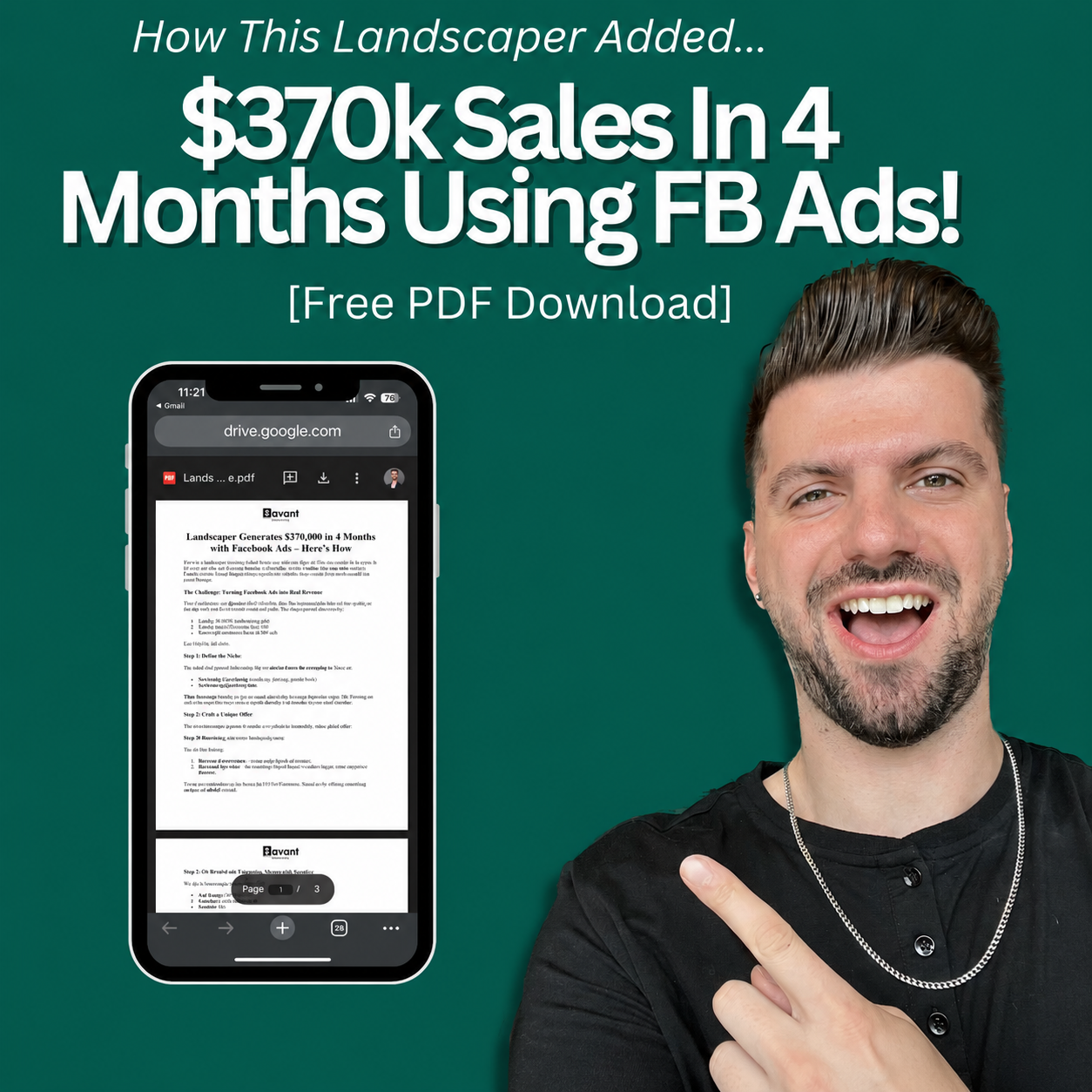
Discover the exact Facebook Ad copy, offer, and creative we used to help our client generate $370,000 in only 4 months.