
Landscapers: Why Your Facebook Ads Attract Tire Kickers (And How To Fix It)
If your Facebook ads are generating leads but most of them feel like tire kickers, the problem may not be Facebook. You might speak with homeowners who immediately ask for a price, tell you they are collecting quotes, or disappear before you can even get them on the phone. After enough of these conversations, it is easy to assume Facebook simply produces low-quality landscaping leads. In many cases, however, lead quality is heavily influenced by how your campaign and sales process are structured. Your offer determines who pays attention, your advertising message determines who responds, and your lead generation process determines how easy it is for someone to become a lead. What happens after that matters just as much, because slow follow-up and a weak sales process can make decent opportunities look like bad leads. If you want better results from Facebook Ads for your landscaping or outdoor living business, you need to look at the entire process instead of judging the platform by the leads sitting in your CRM. Here are five common reasons Facebook leads feel like tire kickers and what you can do to improve their quality.
1.Your Offer Is Attracting the Wrong Homeowners
The first place to look is the offer you are putting in front of homeowners. Many landscaping companies either run ads without a meaningful offer or rely heavily on discounts to generate attention. An ad might simply say, “Looking for landscaping? Contact us for a free quote,” which gives almost anyone a reason to submit their information. The problem is that the homeowner looking for a $1,000 cleanup can respond to the same ad as someone planning a $40,000 backyard renovation. Discounts can create another problem because they can attract homeowners whose main motivation is getting the lowest possible price. Instead, your offer should help qualify prospects based on the type of project you actually want. For outdoor living companies, we often like offers such as a free design mockup because someone interested in a design is more likely to be considering a substantial project. You are still giving the homeowner something valuable, but the offer is connected directly to the service you want to sell. That difference can improve the type of prospect entering your pipeline before your sales team ever makes a phone call.
Specificity also plays a major role in the quality of leads you generate. If your advertisement says you offer “landscaping services,” homeowners have to decide for themselves what that means. One person might interpret landscaping as weekly lawn maintenance, while another might think of a complete backyard renovation. If you want $20,000 patio projects, your advertising should talk specifically about patios instead of landscaping in general. The same principle applies to outdoor kitchens, retaining walls, pools, landscape design, permanent lighting, and other services. Build your campaign around one specific service or project category instead of trying to advertise everything your company can do. You can then create an offer that makes sense specifically for that service. This naturally filters some people out because homeowners who do not want that type of project have little reason to respond. Better lead quality often starts by being much clearer about exactly who you want your advertising to attract.
2. Your Advertising Message Is Too Broad
Your offer and your advertising message work together, but they solve slightly different problems. The offer gives someone a reason to respond, while the message helps the homeowner determine whether your company is relevant to them. If your copy simply says that you are a local landscaping company offering free estimates, there is almost nothing qualifying the person reading it. One simple way to improve this is to use an “if, then” statement near the beginning of your advertisement. You might say, “If you are planning a new patio or backyard renovation this year, then our design team can help you plan the project.” A contractor pursuing larger jobs could get even more specific by mentioning the scope of work, location, timeline, or typical investment involved. People who do not match those conditions can immediately recognize that the advertisement is not intended for them. People who do match them have another reason to continue reading. Your advertising starts doing some of the qualification work before someone ever becomes a lead.
You can take this further when lead quality is more important to you than maximizing lead volume. For example, suppose your company has a $5,000 project minimum and receives dozens of inquiries for jobs below that amount. You could explicitly mention your minimum investment in the advertisement rather than waiting until you speak with the homeowner. This will probably cause some prospects to leave, but that is exactly the point. Losing an unqualified lead before they enter your CRM is better than paying your salesperson to chase them for three days. The same strategy can be applied to the services you provide, geographic areas you serve, and types of projects you want. You do not necessarily need to include every qualification in every advertisement because too many restrictions can hurt response rates. Start with the qualification responsible for the largest number of poor leads and test it. Your goal is not to generate the highest possible number of leads, it is to generate enough qualified opportunities to consistently sell profitable projects.
3. Your Process Has Too Little Friction
Facebook gives landscaping companies several ways to generate inquiries, and the method you choose can have a major effect on lead quality. Three common options are Messenger ads, Facebook lead forms, and sending traffic to a website or dedicated landing page. Messenger has very little friction because someone can start a conversation with only a few clicks. That convenience can increase response volume, but it can also make it easier for people with limited intent to inquire. Facebook lead forms sit somewhere in the middle because you can require homeowners to answer questions before submitting their information. A landing page generally creates more friction because the homeowner has to leave Facebook, visit your page, review your information, and deliberately complete a form. That additional effort can reduce the number of people who become leads. However, the homeowners who complete the process may have stronger intent because they have invested more time learning about your company. If lead quality is your biggest concern, testing lead forms and landing pages against your current campaign can provide useful information.
Facebook lead forms can also be structured to screen prospects before they reach your sales team. Suppose your landscaping company has a minimum project size of $5,000. You could ask prospects directly whether they are comfortable with a minimum investment of $5,000 before allowing them to continue through the form. You can also ask what type of project they want, when they want to start, where they are located, and what approximate budget they have in mind. The purpose is not to make the form unnecessarily difficult, because every additional question can reduce your conversion rate. Instead, ask questions that genuinely help determine whether someone is a potential customer. A contractor selling $50,000 backyard projects may need more qualification than a company selling $3,000 planting packages. Pay attention to what happens further down the sales process instead of looking only at your cost per lead. A $30 lead that never books an appointment is more expensive to your business than a $60 lead that regularly turns into qualified estimates.
Sending Facebook traffic to a dedicated landing page can add another layer of qualification. Your page gives you room to explain your service, show completed projects, feature testimonials, discuss your process, and set expectations before someone contacts you. By the time a homeowner reaches the form, they should have a clearer understanding of what your company does and whether you are a good fit. This approach may increase your cost per lead because you are asking prospects to take additional steps. That does not automatically make the campaign less profitable. If your cost per lead rises from $30 to $50 but your booking rate and close rate improve substantially, the more expensive lead could produce a lower customer acquisition cost. We have also seen cases where adding qualification does not significantly increase lead costs, which is why testing matters more than making assumptions. Compare lead forms and landing pages using actual appointments, estimates, sales, and revenue as your benchmarks. Facebook Ads should ultimately be measured by the business they produce, not by how cheaply you can fill your CRM.
4.Your Appointment-Setting Process
A lead is only the beginning of the sales process. Facebook leads are usually different from referrals because the homeowner may know very little about your company when they submit their information. They may have seen one advertisement, liked what they saw, and decided to request additional information. Meanwhile, that same homeowner may be speaking with one or two other landscaping companies. If their inquiry sits untouched for hours or days, their interest can fade or another contractor can reach them first. Your team should contact new Facebook leads as quickly as reasonably possible instead of treating them like referrals who will patiently wait for you. If the prospect does not answer, that should trigger a consistent follow-up process rather than one phone call followed by silence. Calls, text messages, emails, and additional attempts over the following days can all help you start conversations with people who initially did not respond. A homeowner failing to answer the first phone call does not automatically make them a bad lead.
Your mindset around follow-up also matters. Some contractors believe that if a homeowner is serious, the homeowner should be the one chasing the contractor. That might work when you have a strong referral reputation and someone has already decided they want your company specifically. It is much less effective when dealing with someone who discovered you through an advertisement five minutes ago. Some homeowners are ready to start immediately, while others are researching a project they want completed several months from now. Your job is to determine where they are in that buying process and give them the appropriate next step. That might mean booking an estimate today, scheduling another conversation, sending useful project information, or simply following up at a better time. Over time, these conversations create a pipeline instead of forcing your company to depend entirely on people who are ready to buy today. Facebook advertising works much better when your company has a repeatable process for converting initial interest into real sales conversations.
5. Your Sales Process
The final issue is often blamed on lead quality even though it happens after the lead has already been generated. Many established landscaping companies grow primarily through referrals, repeat customers, builders, or word of mouth. Referral leads often arrive with existing trust because someone the homeowner knows has already recommended your company. Facebook leads do not come with that same level of trust, so your sales process has to create it. This is where advertising can expose weaknesses that were always present but were hidden by strong referrals. If your normal process is to receive an inquiry, immediately drive to the property, email a quote afterward, and wait for the homeowner to respond, cold online leads can be difficult to convert. You need a process that moves a complete stranger from initial inquiry to qualified prospect, estimate, proposal, and decision. That process starts before you ever get in the truck. One of the most important changes you can make is adding a proper discovery call before scheduling an on-site estimate.
The discovery call should determine whether the homeowner and project are worth an in-person visit. Ask what they want built, why they want the project completed, when they hope to start, who is involved in making the decision, and what expectations they have around investment. You can also determine whether they are speaking with other contractors and what they care about when choosing one. If someone wants a $30,000 outdoor living project for $5,000, you should discover that during the phone conversation instead of after spending two hours driving and measuring their property. Once the prospect is qualified, you can enter the estimate with far more useful information. When it is time to present your proposal, present it directly whenever possible rather than simply emailing a number and hoping for a response. This gives you an opportunity to explain the scope, answer questions, handle concerns, and ask for the business. You can also present good, better, and best options where appropriate so the homeowner can compare several project choices rather than making a simple yes-or-no decision. Strong sales processes will not turn every Facebook lead into a customer, but they give qualified prospects a much better chance of becoming one.
Final Thoughts
If Facebook is producing too many tire kickers, changing your targeting or shutting off the campaign should not automatically be your first move. Start by examining the entire path from the advertisement to the sale. Create an offer tied to the specific type of project you want, then write advertising that clearly identifies who the service is for. Add enough qualification to your lead forms or landing pages to filter out obvious mismatches before your team spends time pursuing them. Contact new inquiries quickly and build a follow-up process for homeowners who do not immediately answer. Use discovery calls to qualify projects before committing time to an on-site estimate. Once you meet with a qualified homeowner, use a defined sales process instead of relying on the prospect to sell themselves. Most importantly, track what happens after the lead arrives, including contact rates, appointment rates, estimate rates, close rates, customer acquisition costs, and average project values. When all five parts work together, Facebook Ads can become a much more predictable source of qualified landscaping and outdoor living opportunities instead of a database filled with people asking, “How much?”.

Ready To Take Your Business To The Next Level?
If you’re struggling to DIY your marketing, or you're tired of working with agencies that don’t really understand your business—or worse, don’t seem to care—then maybe it’s time for something different.
Book a quick call with our team. We’ll take the time to understand your unique goals, challenges, and market… and give you a clear, customized strategy to help you grow faster and more efficiently.
No pressure. No sales pitch. Just real insights you can use—whether we work together or not.
Book your free strategy call now.
Download Our Free Case Study
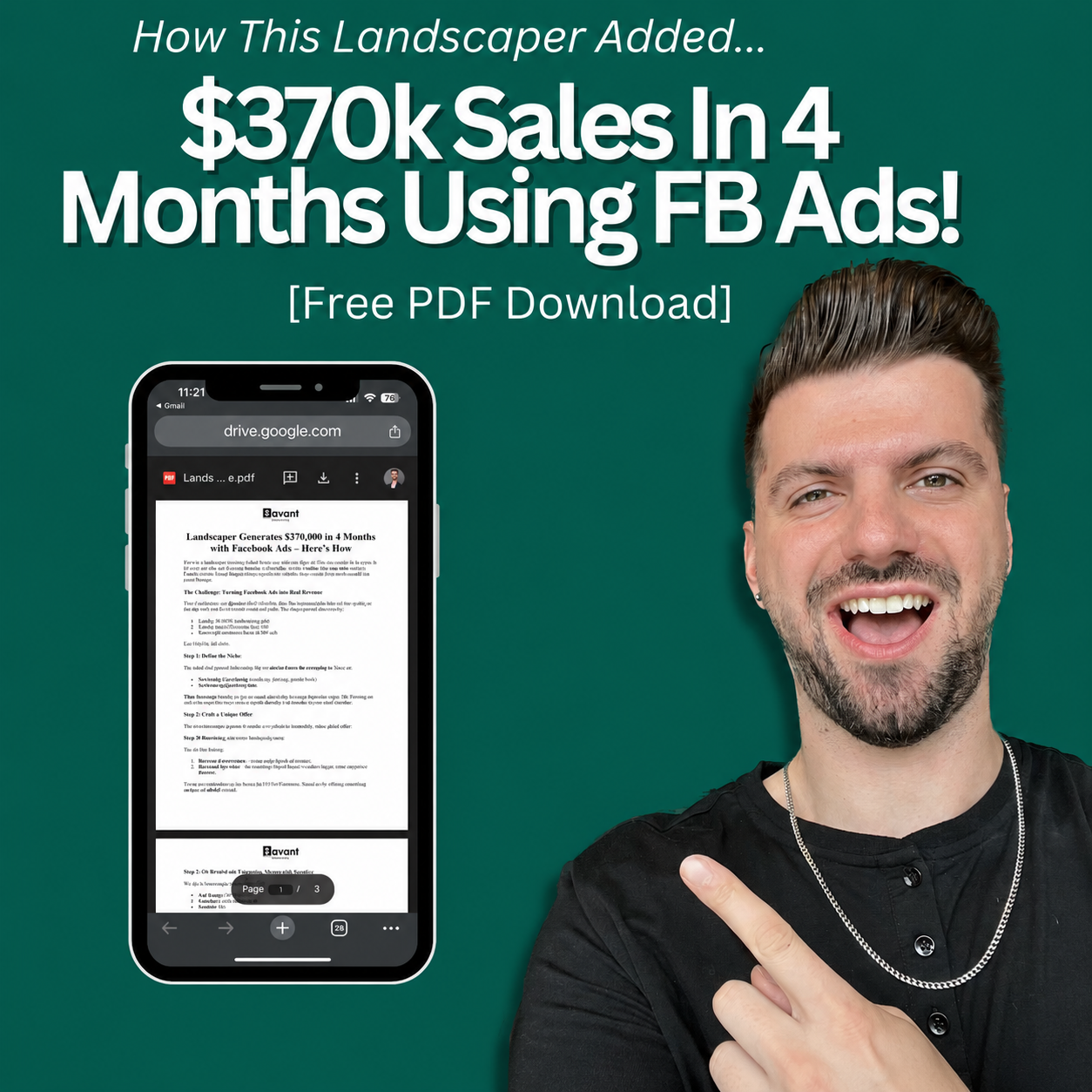
Discover the exact Facebook Ad copy, offer, and creative we used to help our client generate $370,000 in only 4 months.