
How Smart Landscapers DOMINATE Tradeshows
Trade shows can be a great source of new landscaping leads, but simply paying for a booth does not guarantee results. The biggest challenge is getting people to stop long enough to actually speak with you. Attendees are walking past dozens, or sometimes hundreds, of companies competing for their attention. Most booths have banners, brochures, TVs, candy, and branded giveaways, which means those things alone rarely give someone a compelling reason to stop. If people walk past your booth without starting a conversation, you lose the opportunity to learn what they need and determine whether they could become a customer. That is why your trade show strategy should focus less on making your booth look impressive and more on creating conversations. At a recent trade show, we used a simple contest to solve this exact problem. The setup was inexpensive, easy to understand, and gave our team a natural reason to speak with virtually anyone walking past the booth.
How to Get More People to Stop at Your Trade Show Booth
The first objective at any trade show is simple. You need to get someone's attention. A beautiful booth can help, but it still depends on the attendee deciding to approach you first. That puts you in a passive position where your team stands behind a table and waits for someone to show interest. Instead, you want something interactive that gives your team an easy opening to start conversations with people walking past. At our booth, we used a one-gallon jar filled with golf tees and asked attendees to guess how many were inside. The person with the closest guess had a chance to win a $250 Home Depot gift card. Beside the jar, we placed a sign explaining the contest with a QR code attendees could scan to submit their guess. Instead of asking a stranger if they wanted to hear about our company, we could simply ask them a question about the contest.
A contest gives people an immediate reason to interact with your booth without requiring them to be ready for a sales conversation. Imagine someone named Victor walking past your booth wearing the standard trade show name tag. Instead of saying, "Hey Victor, are you looking for landscaping?" you can ask, "Hey Victor, quick question. How many golf tees do you think are in this jar?" That is a much easier conversation to start because there is very little commitment involved. Victor can walk over, look at the jar, make a guess, and potentially win something useful. Once he approaches the booth, the entire interaction changes. You are no longer trying to yell information at someone walking down an aisle. You are standing face-to-face with a person who has voluntarily stopped and is participating in something with you. That creates the opportunity to turn attention into an actual conversation about their landscaping project.
Choose a Prize Your Ideal Customer Wants
The prize matters because it gives attendees a reason to participate. For a landscaping or outdoor living company, a $250 Home Depot gift card is a strong example because it is valuable enough to attract attention and relevant to homeowners interested in improving their properties. You do not necessarily need to give away thousands of dollars or offer your own expensive services for free. The goal is to make participation interesting enough that someone walking past thinks it is worth stopping for a minute. A $100, $250, or similar-value prize may be enough depending on the size and quality of the trade show. The economics can make sense quickly if one conversation turns into a profitable landscaping project. For example, spending $250 on a giveaway is relatively small if the event generates an opportunity for a $10,000 patio, $30,000 landscape installation, or $75,000 outdoor living project. Your specific numbers will depend on your average project size and margins, but the principle remains the same. Spend enough to create attention without allowing the giveaway itself to consume a large percentage of your trade show budget.
Do this correctly, and your booth design can be pretty minimal. Larger displays, televisions, custom furniture, premium booth locations, elaborate signs, and additional electrical requirements can quickly increase your costs. Some of those investments may be worthwhile, especially if trade shows are an important part of your annual marketing plan. The problem is assuming that an expensive booth automatically creates conversations. A massive television playing project videos might look impressive, but attendees can still watch for five seconds and continue walking. Candy and branded merchandise have the same limitation because almost every other exhibitor is offering something similar. An interactive contest gives your team something those passive booth features cannot provide, which is a reason to directly engage someone. You can still have a clean backdrop, examples of your work, brochures, books, testimonials, and other materials available. The contest simply becomes the mechanism that gets people close enough for those other marketing materials to matter.
How To Start Conversations & Qualify Prospects
A contest gives people an immediate reason to interact with your booth without requiring them to be ready for a sales conversation. Imagine someone named Victor walking past your booth wearing the standard trade show name tag. Instead of saying, "Hey Victor, are you looking for landscaping?" you can ask, "Hey Victor, quick question. How many golf tees do you think are in this jar?" That is a much easier conversation to start because there is very little commitment involved. Victor can walk over, look at the jar, make a guess, and potentially win something useful. Once he approaches the booth, the entire interaction changes. You are no longer trying to yell information at someone walking down an aisle. You are standing face-to-face with a person who has voluntarily stopped and is participating in something with you. That creates the opportunity to turn attention into an actual conversation about their landscaping project.
Getting someone to your booth is only the first step. Once they are standing there, your team needs to use that opportunity effectively. You do not need to immediately launch into a rehearsed sales pitch or explain every service your landscaping company offers. Ask simple questions instead. While the person is looking at the jar, you might say, "What brings you to the show today?" or "Are you looking to have any landscape work done?" You could also ask what type of projects they are researching or what they would like to change about their property. These questions allow you to naturally transition from the contest into a conversation about their needs. If someone is planning a $50,000 backyard renovation, you now have an opportunity to discuss it. If they are simply attending the show with no plans to hire a contractor, you can quickly identify that as well. Your booth becomes a place where your team can actively find and qualify potential customers instead of waiting for qualified prospects to identify themselves.
How To Turn Conversations Into Booked Estimates
If an attendee tells you they are actively looking for the exact type of project your company installs, do not automatically send them away with a brochure and hope they call you next week. Ask a few questions about the scope, location, timeline, and what they are trying to accomplish. If the project appears to be a good fit, move the conversation toward a clear next step. That could mean scheduling an on-site consultation, design meeting, discovery call, or estimate depending on your sales process. The attendee is already standing in front of you and discussing their project, so there is little reason to restart the entire process several days later. Booking the next conversation at the booth also prevents good opportunities from being forgotten once everyone returns to their normal routine. Trade shows are busy, and attendees may speak with several competing contractors on the same day. The more clearly you define the next step before they leave, the better chance you have of continuing the relationship.
And if you're not able to book the appointment there, follow up with each prospect. One of the biggest mistakes you can make is treating the trade show as finished when the doors close. Some people who entered the contest may not have been ready for an appointment during the event, but that does not mean they will never become customers. Organize the leads you captured and follow up based on what you learned during your conversations. The strongest prospects should receive personal follow-up from your team, especially if they mentioned a specific project, budget, or timeline. Other entrants can receive relevant communication that reminds them who you are and what your company does. You could also create a post-event offer specifically for people who participated in the contest, provided it makes sense for your business and the audience. An appointment setter can call appropriate leads and restart the conversation by referencing the trade show and contest. This is much warmer than contacting a completely cold prospect because they have already interacted with your company. The key is to treat the contact information you collect as the beginning of the follow-up process, rather than viewing the number of contest entries as the final measure of success.
Measure Results That Actually Matter
A busy booth can feel successful without producing much revenue, so track the numbers that matter. Start by recording how many contest entries you received and how many meaningful conversations your team had during the event. Then track how many of those conversations were qualified, how many appointments were booked, how many estimates were delivered, and how many projects eventually closed. You should also calculate the total revenue generated from those projects and compare it against the full cost of participating in the show. That cost includes the booth, travel, staffing, promotional materials, giveaway, and any other event expenses. These numbers tell you whether the show produced business instead of simply producing traffic. They also give you benchmarks you can improve the next time you exhibit. If hundreds of people entered but very few appointments were booked, your qualification or conversation process may need work. If you booked plenty of appointments but few became jobs, the issue may be further down your sales process.
Final Thoughts
The best trade show strategy does not necessarily require the biggest booth in the building. You need a reliable way to get attention, start conversations, identify qualified prospects, capture their information, and move good opportunities forward. A simple guessing contest can accomplish each of those objectives without requiring a massive investment. Put an interesting item in a jar, offer a relevant prize, create a simple entry form with a QR code, and train your team to invite people to participate. Once attendees approach, use the opportunity to learn why they came to the show and whether they have an upcoming landscaping or outdoor living project. Capture their information so you can continue communicating after the event, but prioritize booking qualified opportunities while you still have them standing in front of you. After the show, follow up consistently and track how many entries eventually become appointments, estimates, jobs, and revenue. That gives you a much clearer picture of whether trade shows deserve a larger role in your marketing strategy. When the system is built around real conversations instead of simply having a good-looking booth, a trade show can become a measurable source of new landscaping opportunities.

Ready To Take Your Business To The Next Level?
If you’re struggling to DIY your marketing, or you're tired of working with agencies that don’t really understand your business—or worse, don’t seem to care—then maybe it’s time for something different.
Book a quick call with our team. We’ll take the time to understand your unique goals, challenges, and market… and give you a clear, customized strategy to help you grow faster and more efficiently.
No pressure. No sales pitch. Just real insights you can use—whether we work together or not.
Book your free strategy call now.
Download Our Free Case Study
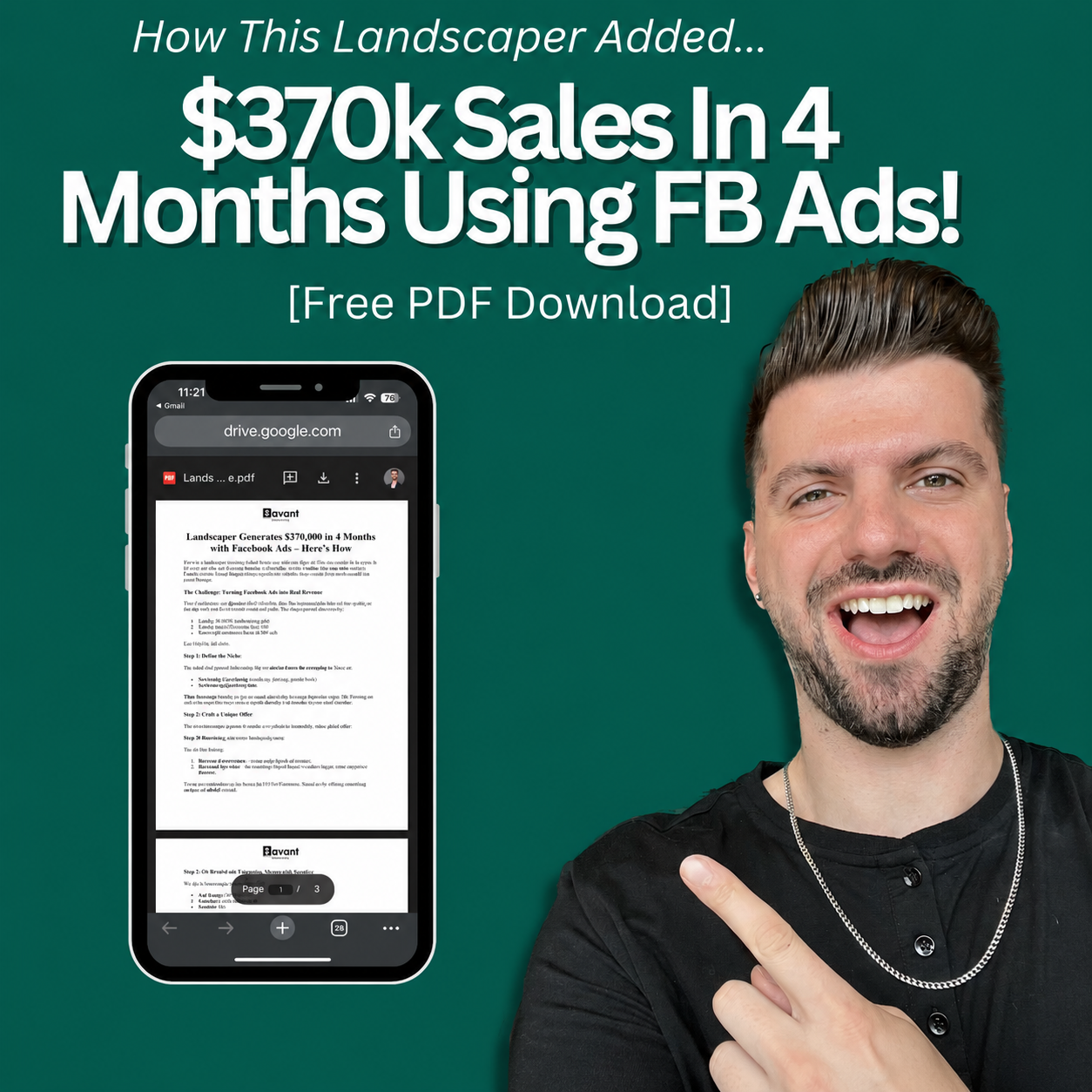
Discover the exact Facebook Ad copy, offer, and creative we used to help our client generate $370,000 in only 4 months.